
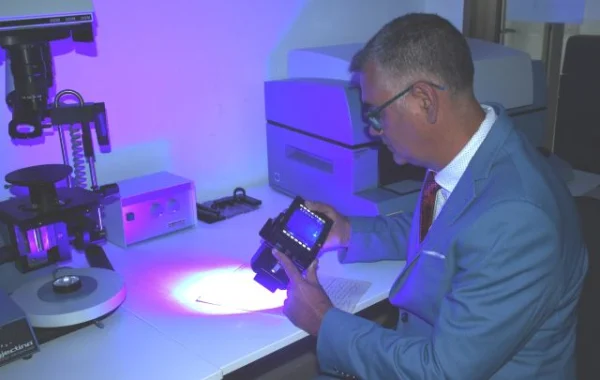
Forensic document examination and handwriting analysis reveal a previously unknown literary work, highlighting the role of forensic techniques in cultural heritage authentication.
Rito Martín, a specialist in handwriting analysis, criminology, document examination, and forensic expertise in intellectual and industrial property, carefully analyzed eighty-six unsigned handwritten pages attributed to Alonso Quesada. These documents were discovered by Yolanda Arencibia among the files deposited years ago in the archive of the Tomás Morales House Museum in Moya by Quesada’s daughter.
As President of the Canary Islands Society of Experts in Document Examination and Handwriting Analysis, Martín has enabled the inclusion of a new, previously unpublished work titled Doña Juana y sus hijos into Quesada’s literary corpus with full guarantees. The work is described as an intriguing traditional theatrical piece structured by Quesada into eleven scenes.
On April 24 at 19:00, Rito Martín will deliver a lecture at the Tomás Morales House Museum in Moya, which houses the Alonso Quesada archive. Titled “Certifying a Work: Forensic Techniques Applied to Art. Identification of Alonso Quesada’s Texts,” the presentation is part of the centenary program commemorating the poet’s death, organized by the Department of Culture of the Gran Canaria Cabildo. During the lecture, Martín will present the complex expert analysis carried out on the recovered texts. These materials, which show signs of erasures and tears caused by the passage of time, have been published in book form within the “Dramaturgias Insulares” collection by the same department.
Quesada’s Fingerprint
During the lecture, Martín will also examine the relationship between his initial training in criminology, his later specialization, and his professional work as a forensic expert, particularly in relation to the application of forensic techniques to the authentication of artworks. To illustrate this, he will present examples and photographs of discoveries made in various works.
Among his many commissioned works is a study requested by TEA (Tenerife Espacio de las Artes) on the authenticity of a notebook attributed to the surrealist painter Óscar Domínguez. Attendees will learn about the different stages Martín followed to determine that the previously unknown work was indeed written in Alonso Quesada’s own handwriting, as well as other aspects of forensic interest. At this stage, they will also be able to observe the fingerprint left by Alonso Quesada when his finger came into contact with the manuscript while writing with still-wet ink.
Rito Martín states that when facing a new challenge such as authenticating a work of art in a laboratory, a wide range of emotions arise. “The first is responsibility; therefore, when dealing with a historical and cultural heritage that belongs to all of us, we take every possible safety measures. It is important to remember that over time, artworks, their supports, and their materials deteriorate, so we must be extremely careful. At the same time, we also feel a responsibility in obtaining results that may have significant consequences.”
He continues: “Finally, we cannot deny that it is a great privilege to have direct access to the works of major figures of our culture and to be able to discover hidden elements—such as a fingerprint, a signature in a painting, or a design altered by the artist and left beneath layers of paint—and reveal them without causing any damage.”
Since the late 1990s, Martín has been interested in the relationship between criminology and historical heritage. His academic work focused on crime and archaeological heritage. According to him, multidisciplinary teams remain essential for the advancement of science, just as they were in the past. Chemists, historians, restorers, criminologists, and other specialists are indispensable. He also notes that forensic equipment such as ForenScope can provide valuable insights into documents, paintings, cave art, and ceramic materials.