
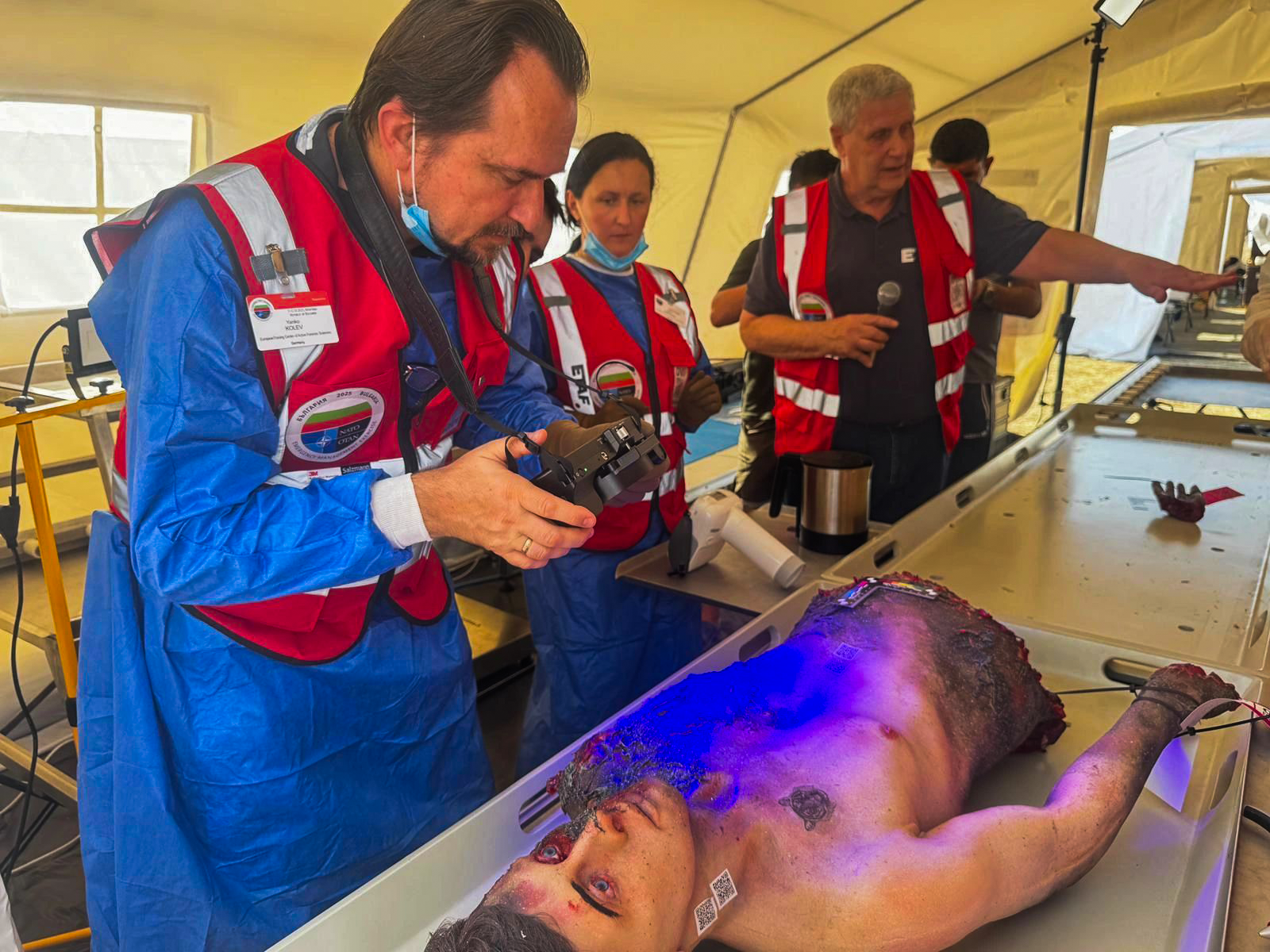
DVI Researcher with SuperSpectral System in the Photo: Dr. Yanko Kolev MD, PhD
Supporting Reliable Post-Mortem Documentation in Complex Disaster Environments
The European Training Center for Advanced Forensic Sciences and Disaster Victim Identification (ETAF-DVI) participated as a partner in the NATO Emergency Management Exercise held in Montana, Bulgaria, between 8–11 September 2025. Working alongside multinational first-responder teams from diverse backgrounds, ETAF-DVI units actively took part in body recovery operations and disaster scene interventions. Live demonstrations of victim identification carried out in accordance with INTERPOL protocols attracted significant attention from both participants and the media.
During this important international exercise, the ForenScope SuperSpectral was among the technologies used to support forensic examinations and victim identification processes. Its role in this environment highlights the growing importance of advanced imaging systems in modern DVI* (Disaster Victim Identification) operations.
Why DVI Requires Advanced Forensic Imaging?
Disaster Victim Identification relies on the accurate collection, preservation, and comparison of post-mortem data. In mass fatality incidents, this work must often be carried out under time pressure, in challenging environmental conditions, and across multidisciplinary teams. In such scenarios, reliable documentation is of critical importance.
Post-Mortem Data Relies On:
• Fingerprints
• Odontology or dental examination
• DNA profiling
• Physical markers such as tattoos, scars, or surgical implants that may be unique to the victim
Each of these elements contributes to the identification process, and each requires clear, accurate, and well-preserved documentation. The better the visual and forensic record, the more straightforward the identification process becomes.
ALS in Field Investigation: The First Phase of DVI
The Alternate Light Source (ALS) capability of SuperSpectral is not limited to post-mortem examination settings. It can also play a critical role during the first phase of DVI, the initial field investigation at the disaster scene itself.
This is especially relevant in cases where the incident is not a natural disaster, but a suspected crime, an act of mass violence, or an unnatural accident. In such scenarios, the forensic approach shifts from a purely humanitarian identification mission to a criminal investigation framework. It requires the same rigorous evidence-collection standards applied in any serious crime scene investigation, but scaled to mass fatality conditions.
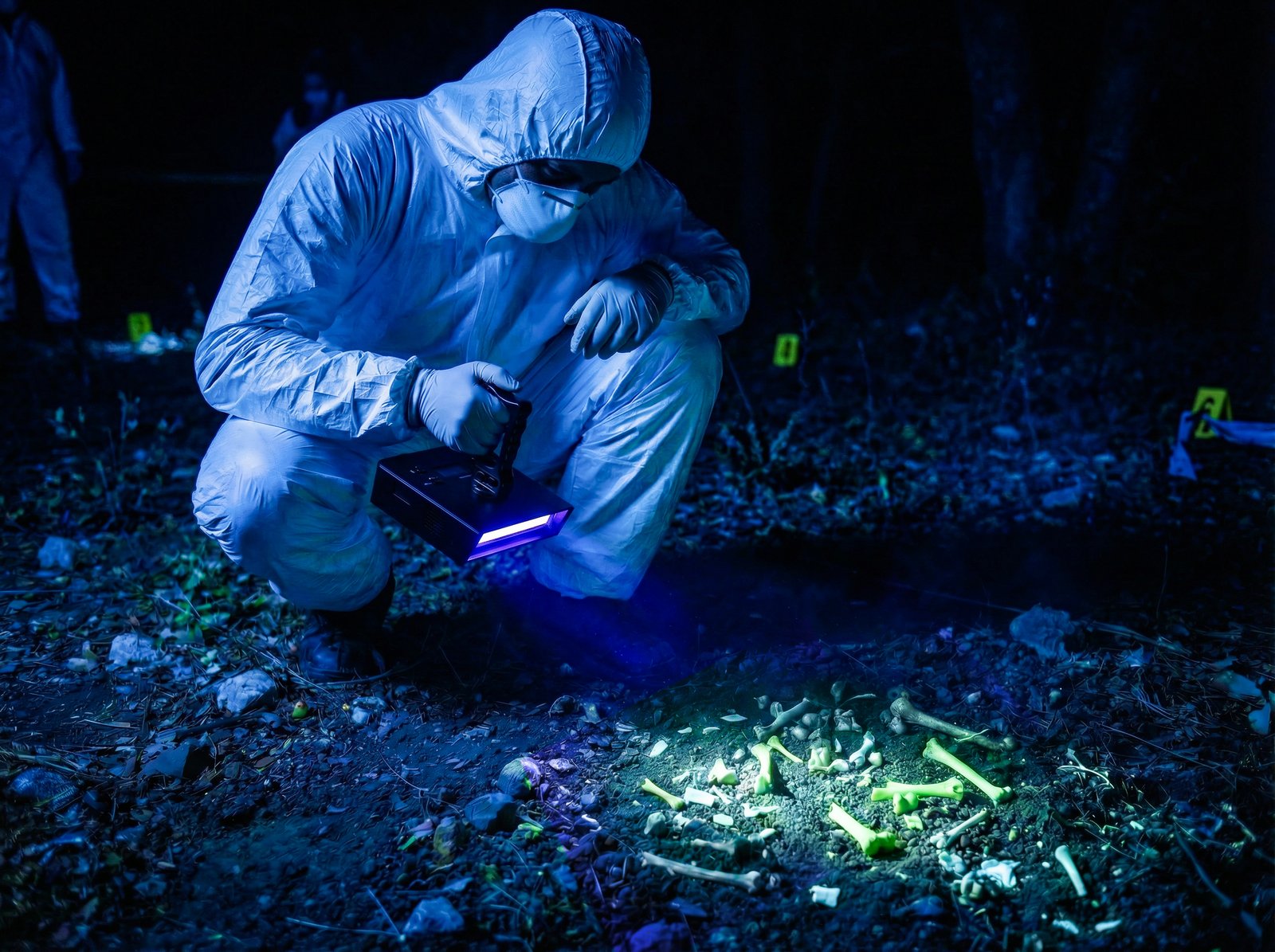
Battlefield Forensics and Mass Crime Scene Investigation
In what is increasingly referred to as “Battlefield Forensics” is a discipline covering war crimes, terrorist incidents, and mass casualty events with criminal dimensions. ALS-enabled imaging can support the earliest stages of scene documentation. Much like a conventional crime scene investigation (CSI) protocol, but applied to an event with mass fatalities, the first responders must:
• Document trace evidence before it is disturbed or degraded
• Identify biological materials, latent marks, or surface residues
• Establish the integrity of the scene for subsequent forensic and legal processes
• Support chain-of-custody documentation of physical evidence
The ALS capability of SuperSpectral enables forensic personnel to detect fluorescent traces, biological stains, and surface markings in the field. This contributes directly to the evidentiary quality of the overall DVI process when criminal accountability is a consideration.
The Significance of SuperSpectral in DVI
SuperSpectral supports DVI operations by helping forensic teams visualize details that cannot be clearly seen under standard lighting conditions. In post-mortem examinations, this can be of particular significance in documenting physical markers, skin findings, trauma patterns, or trace evidence that may contribute to identification and forensic assessment.
Enhanced imaging capability allows teams to work with greater clarity under challenging conditions, supporting the structured collection of post-mortem data while also contributing to the preservation of evidence integrity. In disaster scenarios where conditions are often far from ideal, technologies that improve visibility without complicating the workflow can make a meaningful difference.
An All-in-One Forensic Imaging Approach
One of SuperSpectral’s most significant advantages is its all-in-one structure. Rather than relying on multiple separate tools for different examination needs, forensic specialists can use a single integrated system to support a broader range of documentation tasks.
Why Does This Matter for DVI?
Speed and organization are of great importance in disaster victim identification. An all-in-one system helps reduce equipment complexity, simplify field deployment, and support smoother coordination during post-mortem examinations. This is particularly valuable in temporary morgues, mobile forensic units, or disaster response environments where time, space, and operational control are of critical importance.
By consolidating multiple imaging capabilities into a single device, SuperSpectral helps forensic teams to:
• document physical findings more efficiently
• reduce dependence on multiple separate tools
• improve workflow consistency
• support clearer visual records for post-mortem assessment
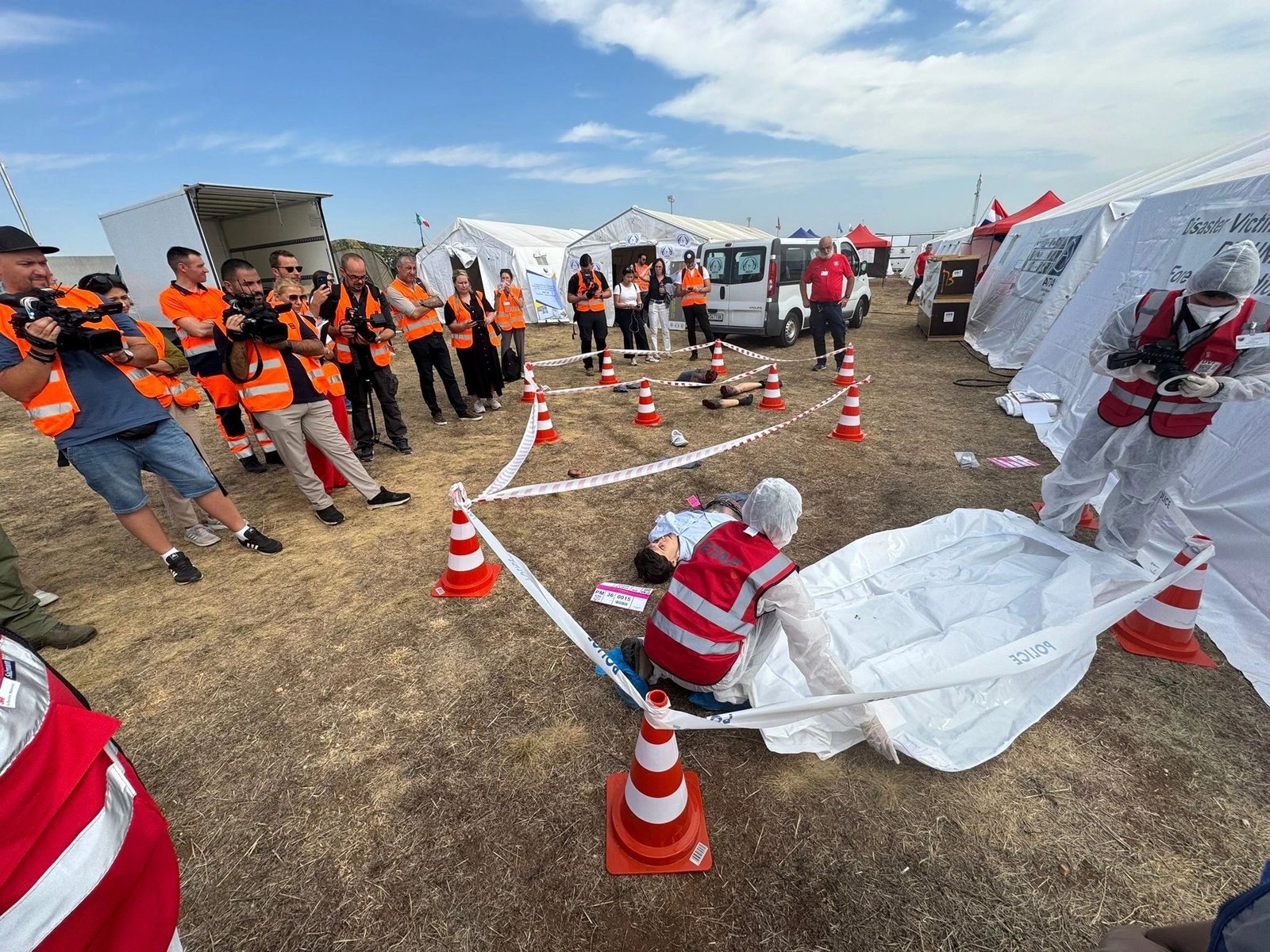
Supporting the Identification of Physical Findings
While fingerprints, odontology, and DNA remain the primary pillars of DVI, physical markers also play a significant role in narrowing down and confirming identity. Tattoos, scars, old injuries, skin markings, and other visible or semi-visible features can all contribute to the post-mortem record.
SuperSpectral strengthens this part of the process by helping to reveal and document findings that may be difficult to observe under traditional examination conditions. This makes SuperSpectral a valuable support tool not only for forensic imaging, but for the broader identification workflow as well.
Strengthening International DVI Preparations
At this event, governed by NATO Emergency and Crisis Management Regulations, the use of SuperSpectral demonstrated that forensic specialists in modern DVI operations are able to work faster under pressure and achieve better documentation outcomes.
Disaster Victim Identification is one of the most demanding areas of forensic work. It requires accuracy, discipline, and tools that can perform reliably in high-pressure environments. By supporting the documentation of physical findings and offering an all-in-one imaging solution, ForenScope SuperSpectral contributes to a more efficient and robust DVI workflow.
As international emergency exercises continue to evolve, the role of advanced forensic imaging in victim identification will become increasingly important. SuperSpectral is positioned as part of this evolution.
*DVI (Disaster Victim Identification) is a systematic forensic process conducted to internationally recognized standards, used to identify individuals who have lost their lives in major disasters.