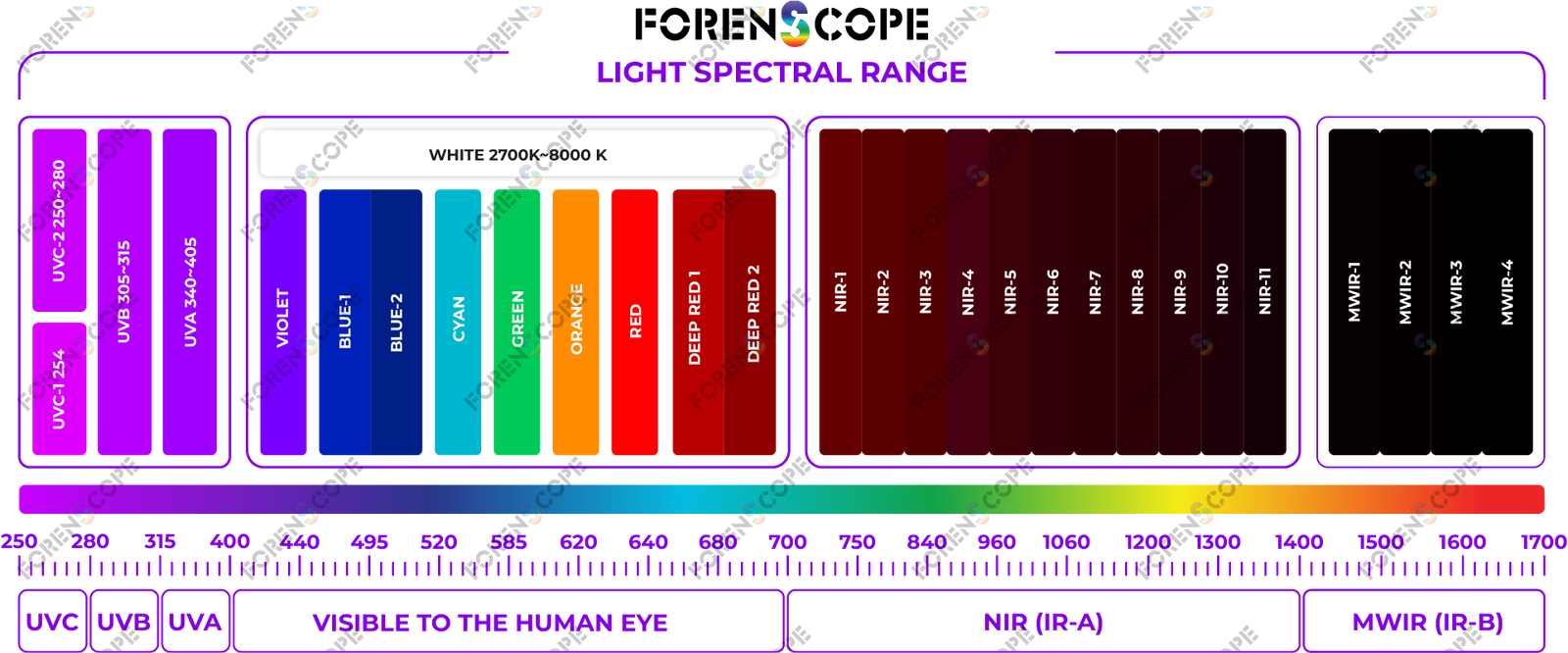
What is SuperSpectral and MultiSpectral?
Digital cameras used in daily life typically feature Bayer pattern color filtering and data processing architectures; in certain specific fields, Tri-linear sensors are utilized. However, in specialized areas requiring high precision, such as Forensics or medical diagnosis/screening, standard RGB (Red-Green-Blue) wavelength bands are insufficient. In addition to these bands, there is a need for multi-band imaging systems that cover invisible spectral regions such as UV (Ultraviolet), NIR (Near-Infrared), and SWIR (Short-Wave Infrared).
Consequently, there has been a transition from systems that capture broad-band images only in the visible spectrum to systems capable of visualizing specific wavelength ranges by utilizing both visible and invisible spectral bands. To fully grasp this technology, one must first answer the question: “What is Spectral Imaging?“
What is Spectral Imaging?
What is the Electromagnetic Spectrum?
It is a scientific classification encompassing all types of radiation, from radio waves to gamma rays, representing a holistic structure. The human eye can only perceive a very narrow portion of this spectrum (visible light). However, advanced scientific devices and optical sensors developed by ForenScope, such as SuperSpectral and MultiSpectral systems, render details in the invisible layers of the spectrum visible.
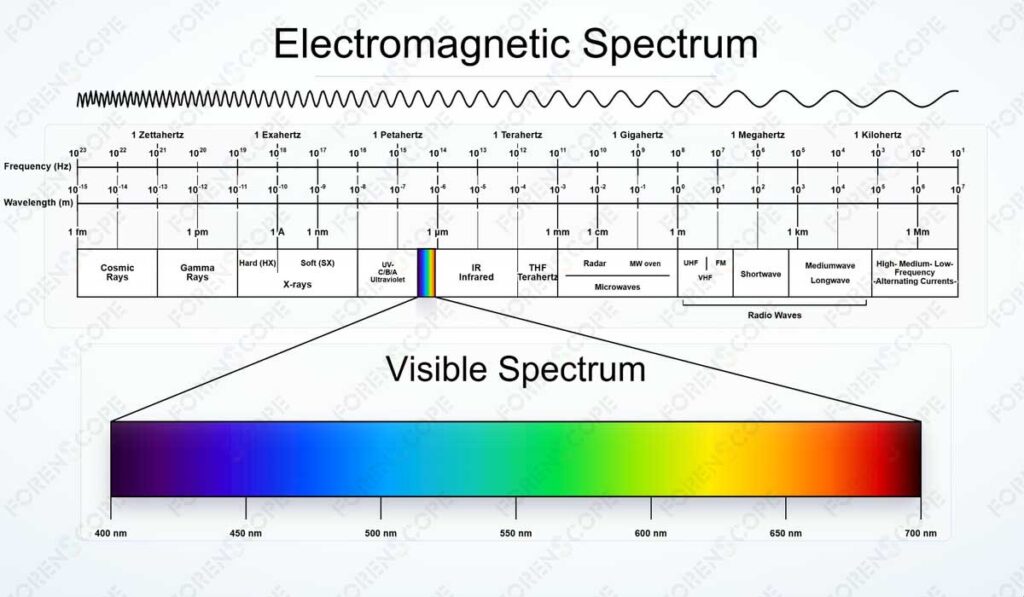
What is a Spectral Band?
Visible Bands: These cover the blue, green, and red light ranges; all colors we see in daily life are defined within these wavelengths.
Invisible Bands: Spectral imaging allows us to capture information at wavelengths that the human eye cannot detect. Thanks to this technology, critical data can be obtained from invisible bands such as Infrared (IR)—including NIR (Near-Infrared), LWIR (Long-Wave Infrared), and SWIR (Short-Wave Infrared)—as well as UV (Ultraviolet), Microwaves, and X-Rays.
What are MultiSpektral and SuperSpectral Imaging?
Certain materials reflect and absorb light differently at various wavelengths. This makes it possible to distinguish targets in remotely sensed images based on their spectral reflectance properties. Imaging systems are grouped according to their number of spectral bands. In this classification, the fundamental difference between Multispectral and SuperSpectral is the number of bands and how narrow those bands are.
Multispectral Imaging
SuperSpectral Imaging
What is Hyperspectral Imaging?
Hyperspectral Imaging
In contrast, SuperSpectral technology allows for the acquisition of rapid, high-resolution data by using strategic wavelengths, especially in processes such as the detection of biological remains or fingerprint imaging. Today, while the most advanced hyperspectral cameras outside of satellite and military use provide a maximum resolution of 1000×1000 pixels per band, the SuperSpectral Force device boasts a much higher imaging ratio of 16,384 x 12,288 pixels. For these reasons, although ForenScope has utilized hyperspectral technologies for certain R&D projects, it believes that hyperspectral technology still requires further development to balance the speed, high resolution, mobility, and affordability required for routine use in its core fields.
MultiSpectral and SuperSpectral imaging technologies are of critical importance in forensic investigations. Forensic experts can detect bloodstains on dark or multi-colored surfaces, body fluids such as semen and urine that are invisible to the naked eye, and bone/tooth fragments hidden among stones, sand, and soil through spectral analysis. Furthermore, they can identify Gunshot Residue (GSR) on hands or dark/multi-colored clothing and examine documents to uncover evidence that might be missed by traditional methods. These advanced techniques ensure that crimes are solved and definitive evidence is presented in the judicial process.
*This informative text has been prepared by Osman Eşki, Head of R&D Team, with ForenScope’s expertise in SuperSpectral and MultiSpectral imaging technologies.