Prof. Dr. Hakan Kar, MD – Professor of Forensic Medicine, Sexual Assault Examiner, Mersin University Medical Faculty
SAFE (Sexual Assault Forensic Examination) Imaging Systems allow the detection of semen residues thanks to their light and filter combinations, which are invisible to the naked eye.
One of the diagnostic findings in cases of sexual assault is the presence of sperm in samples collected from the victim. It is reported that evidence was discovered in more than 90% of the cases admitted within 24 hours, that the evidence was obtained primarily from underwear, and that no significant results were acquired in analyses conducted after 24 hours. It is based on the detection of sperm in vaginal, anal, and oral swabs, or the finding of epithelial cells in saliva on swabs taken from body areas that come into contact with the mouth, as well as DNA analysis and comparison to the suspect’s DNA. The same applies to biological materials, including blood, sperm, and saliva collected from clothing, napkins, or other surfaces. In addition, identification involves isolating the victim’s DNA from biological components collected from the suspect’s penile swabs. In a meta-analysis of various studies, the sperm detection rate ranges from 13% to 63%. These rates may differ depending on the duration between the sexual assault and sampling, the sampling location, and the examination method used. Although methylene blue and hematoxylin-eosin staining are extensively employed, the World Health Organization (WHO) recommends that air-dried swab samples be examined at 10×100 magnification with immersion oil after sperm dye application, such as Papanicolaou, Shorr, or Diff-Quik. Although the first 24 hours for oral penetration, the first 48 hours for anal penetration, and the first 72 hours for vaginal penetration are regarded as critical for sampling, the duration of forensic evidence collection might be defined as the first 120 hours in teenage and adult cases. In cases of condom use, incorrect technique or method selection in sample collection and laboratory testing, azoospermia, vasectomy, the presence of antisperm antibodies, late examination, sperm entering the uterus, etc., sperm may not be detected by direct microscopy even though ejaculation has occurred. Although spot or specific assays with diagnostic significance, such as prostate-specific antigen (P30) and prostatic acid phosphatase (PAP) found in semen, are used at this stage, Y-STR DNA analysis is the gold standard test according to current guidelines. STR polymorphisms specific to the Y chromosome are especially useful in sexual crime situations where the aggressor is male and the victim is female, resulting in a mixture of male and female DNA. In these circumstances, a small amount of the perpetrator’s DNA combined with a substantial amount of the victim’s DNA can be effectively typed using solely Y chromosome-specific primers. Furthermore, even if there is no ejaculation, epithelial transfer from the male penis or finger can occur during vaginal penetration.
Clothes, particularly underwear, are a valuable source of DNA, and biological materials belonging to the attacker should be searched for on clothing. Clothes intended to be used as evidence should be packed in dry paper bags and tagged. For DNA analysis, the dry technique is preferred for oral sampling, and the wet-dry technique is preferred for other types. It is advised that the samples used for DNA analysis be transported to the laboratory with a cold chain within the first three hours, or at +4 degrees Celsius. In sexual assault cases, perpetrators may hide or wash clothes with seminal stains. Spermatozoa were found on cotton and towels after six washing cycles when examined under a microscope. Considering the likelihood of evidence being washed away after the incident, the fact that spermatozoa can be found in washed materials is vital. These findings demonstrate the need for collecting and examining evidence such as clothing and bedding, even if they have been washed previously.
For oral sampling, the teeth edges, gingival margins, buccal and lingual surfaces, and soft and hard palate; for vaginal sampling, the external genital folds, perineum, posterior vaginal pool, and cervical orifice; and for anal sampling, the perianal region and anal canal are recommended. In addition, samples should be taken from any foreign materials found on the victim’s body, including bite and suck marks, wounds, and nails broken during the attack. At this stage, a fine-toothed comb can be used to collect samples from the pubic hair. It is advised that the nails be entirely clipped, and if they are too short, scrapings should be taken from under the nails. The DNA profiles collected from all of these samples can be compared to the DNA profiles of the suspects to provide high-precision evidence. It is also possible to collect samples from the suspect both during and after the examination. Blood can be collected for DNA profiling, hair samples for comparing transferred hair, blood and urine for alcohol and substance usage, and a penile swab sample for detecting a sexual encounter. The presence of vaginal epithelial cells in the microscopic examination of the swab sample is significant because it suggests penile-vaginal contact. A study found that the victim’s DNA can be detectable in penile swab samples for up to 24 hours if there is no shower or washing.
Finding sperm in the sample is an important step toward identifying the offender. Even if the offender’s sperm is present on the victim’s body and/or clothing, samples obtained using only the naked eye are unlikely to contain it. Sperm can be detected by fluorescence through the various light filters used by Forenscope SAFE (Sexual Assault Forensic Examination) Imaging Systems. This is critical for identifying the area that needs to be sampled. Using these samples as evidence will make it significantly easier to hold the perpetrators of crimes accountable.
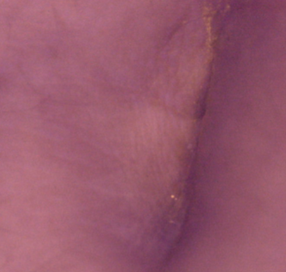
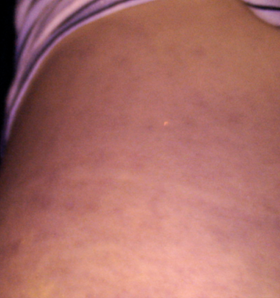
Fig 1: Suspected Semen residues become visible with D1 & D2 Semen detection function of Forenscope SAFE Imaging Systems
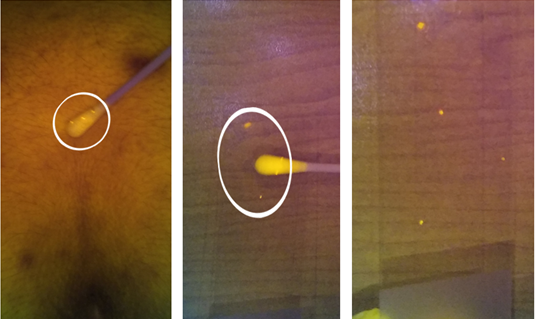
Fig 2: Live Video sampling with D1 & D2 Semen detection function of Forenscope SAFE Imaging Systems
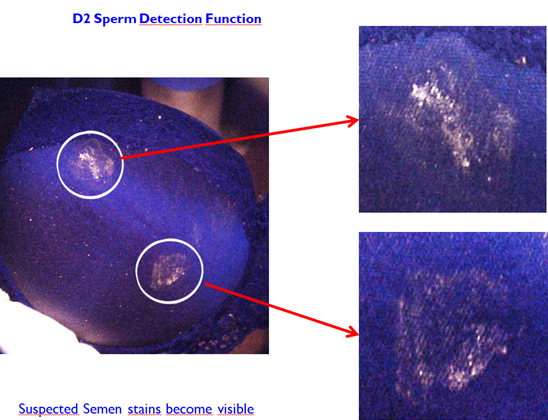
Fig 3: Semen stains becomes visible with D1 & D2 Semen detection function of Forenscope SAFE Imaging Systems on fabrics