
Operating Wavelengths of ForenScope UV-VIS-NIR-MWIR Imaging Systems
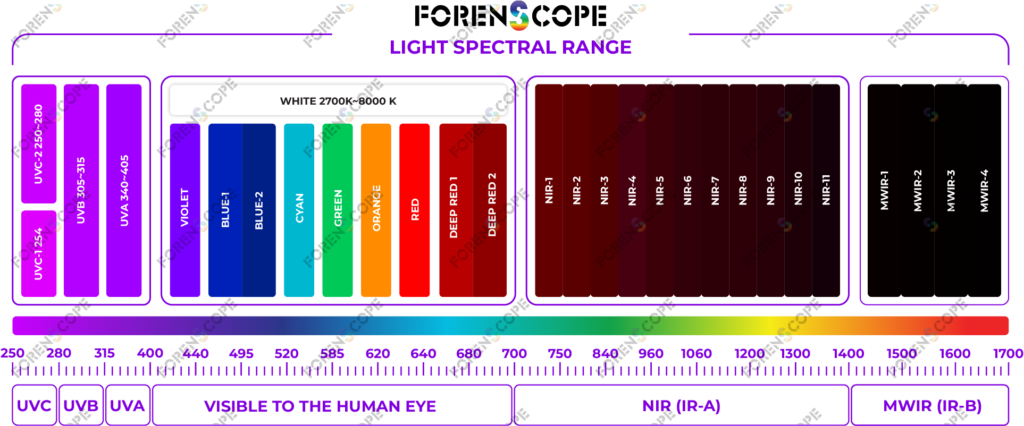
The following ranges represent the narrowband light operating spectrums utilized in ForenScope’s UV-VIS-NIR-MWIR all-in-one systems and its R&D-supported standard devices:
1. Ultraviolet (UV)
Refers to the 10-400nm wavelength range, classified as VUV, UVC, UVB, and UVA. The operating range of ForenScope imaging devices (such as the 8K and 4K models) begins at 180±20nm and covers all UV wavelengths up to 400nm. Advanced ForenScope sensors, optical lenses, filters, and light sources render even the most challenging forensic evidence visible through this extensive operating range.
1.1 Vacuum UV (VUV: 10-200nm)
Also referred to as Extreme UV (EUV) and Far UV (FUV). VUV encompasses EUV (10-121nm) and FUV (122-200nm). ForenScope 8K and 4K devices utilize UV lenses manufactured from specialized materials capable of transmitting light starting from the 180±20nm range, operating near the Vacuum/Extreme UV boundaries.
1.2 UVC (200-280nm)
Also known as Ultraviolet-C, Deep UV, Short-wave UV, or Far-UVC. While much of the literature defines UVC as 100-280nm, ForenScope 8K and 4K devices operate efficiently in the 180-280±20nm range, supported by specialized UV lenses, customized UV sensors, Band Pass UV filters, and UVC-emitting light sources.
ForenScope 4K and 8K devices are equipped with hardware for emission, filtration, and imaging at 254nm and various other UVC wavelengths.
1.3 UVB (280-315nm)
Also referred to as Ultraviolet-B, Medium-wave UV, or B-Band UV. ForenScope 8K and 4K devices operate with full sensitivity within the 280-315nm wavelength range.
1.4 UVA (315-400nm)
Also known as Ultraviolet-A, Long-wave UV, or Blacklight (Wood’s Lamp). ForenScope 8K and 4K devices operate with full sensitivity between 315-400nm, while devices such as SuperSpectral and t-Zoom operate in the 330-400±20nm range.