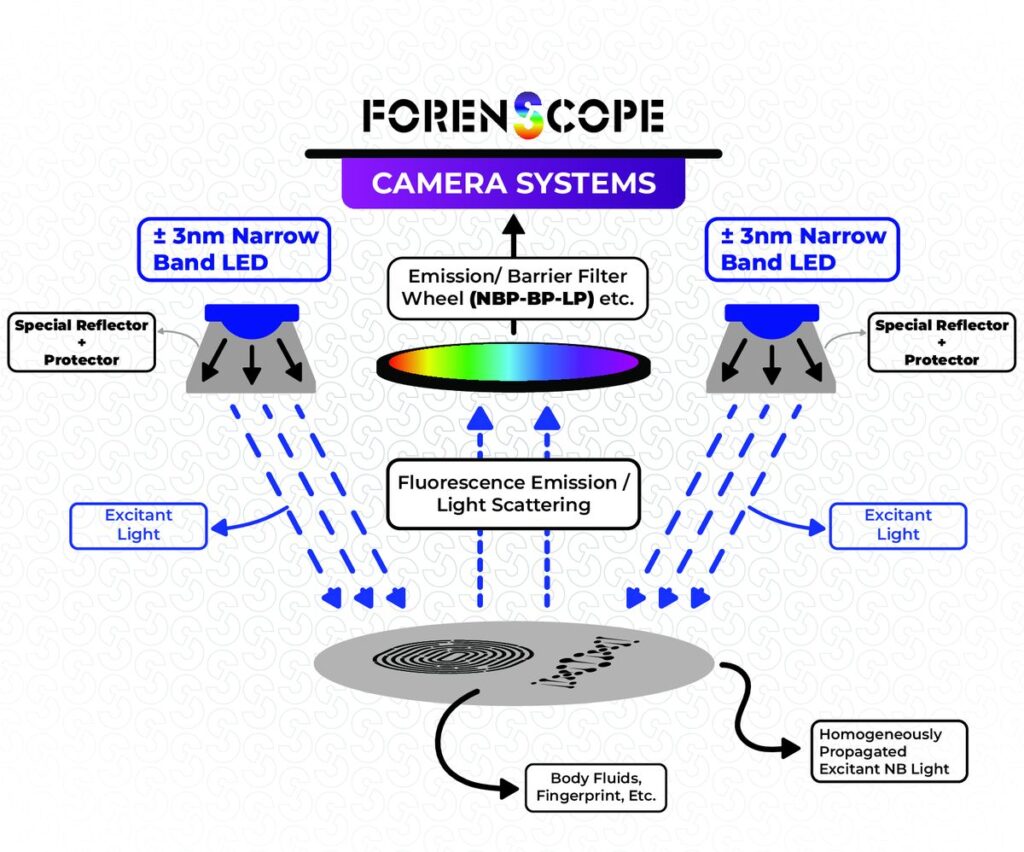
Working Principle of ForenScope SuperSpectral and MultiSpectral (UV-VIS-NIR-MWIR) Systems
The interaction between matter and light is based on the principles of transmission, absorption, and reflection. Each spectral band exhibits different interactions depending on the structural properties or chemical components of the objects.
ForenScope Systems primarily operate through two main mechanisms:
1. Excitation of Fluorophores (fluorophore/fluorochrome)
Absorbing energy at specific wavelengths, defined as the “excitation range,” and re-emitting this energy at a longer wavelength, known as the “emission range.”
2. Infrared (IR) Contrast
ForenScope mobile and laboratory systems are designed to capture these optical phenomena with the highest precision. This engineering approach allows for high-contrast and sharp imaging of complex evidence, such as body fluids or lesions hidden on/under the skin surface, even from a distance. This technological superiority is provided by the following components:
NARROW BAND ILLUMINATION:
ForenScope systems use customized Narrow Band LED technology with ±3nm precision to ensure maximum efficiency in exciting the target fluorophore. Thermal stability and optical guidance play a critical role in this process. As a strategic choice, ForenScope avoids using excitation filters whenever possible. Instead, it utilizes direct narrow-band LEDs. This prevents photon loss and energy quenching caused by filters, resulting in higher excitation levels at the atomic level and clear fluorescence emission.
Thermal Management
To ensure LEDs emit consistently at the same Center Wavelength (CWL), copper/aluminum heatsink structures and aluminum body integration developed by our R&D team are used. This system prevents heat-induced spectral shifts and guarantees consistent operation.
Optical Design and Reflectors
The angles of the reflectors designed by our R&D team center the camera, focusing narrow-band light onto the inspection area with high photon density and homogenous delivery.
ABSORPTION MECHANISM
Maximum absorption is achieved through narrow-band illumination at precisely selected bands, high-intensity photon focusing, and specialized reflector technology. Spectrally separating excitation and emission wavelengths to trigger selective absorption optimizes the Signal-to-Noise Ratio (SNR), maximizing contrast sharpness.
Light absorption occurs when photon energy resonates with the natural vibration frequency of electrons at the atomic level. The energy absorbed during this resonance is transferred to neighboring atoms via a thermal transfer mechanism. ForenScope technology triggers this molecular interaction by directing Narrow Band LEDs with ±3nm precision directly toward the target through customized reflectors. Consequently, the selective absorption capacity of evidence with varying molecular structures is maximized.
REFLECTION (Fluorescence Glow and Optical Reflection):
Maximum fluorescence glow is obtained when excited fluorophores re-emit absorbed energy at a longer wavelength. Light reflection occurs when the vibration frequency of electrons does not match the incoming light. Narrow Band LEDs and special reflectors prevent uncontrolled scattering, ensuring the excited emission process occurs at the highest energy level. This allows ForenScope systems to isolate even the weakest fluorescent traces from the background with a high-contrast “perfect glow.”
EMISSION / BARRIER FILTERING
The Emission/Barrier Filter Wheel (NBP-BP-LP) integrated in front of the imaging sensor is the most critical stage of optical filtration. These filters, specifically designed for sensor spectral sensitivity by the ForenScope R&D team, maximize contrast by eliminating excitation light and allowing only the target fluorescence to reach the sensor. Our multi-layer barrier structure is optimized to capture weak photons with high efficiency.
The Narrow Band Pass, Band Pass, Long Pass, and IR / UV / VIS Pass filter sets utilized in our systems provide maximum attenuation of the excitation light while capturing weak fluorescent photons with high efficiency. Since each type of evidence in forensic investigations requires distinct spectral responses, the multi-layer barrier structure in our devices is optimized to achieve the clearest reflection.
This unique engineering solution fully isolates background noise, ensuring that even the lowest emission signals are converted into clear, high-resolution visuals.
CAMERA AND IMAGE QUALITY INTEGRATION
Sensor Technology
Each sensor is unique to its spectral characteristics. The narrow-band illumination and barrier filters developed by our R&D team are fully compatible with the quantum efficiency of these sensors, maximizing the optical SNR.
High-Resolution Imaging
The integration of high pixel density sensors with high screen resolution allows for detailed analysis during digital or optical zoom without loss of spatial resolution.
Conclusion
The integrated structure created by these advanced engineering stages—narrow band illumination, thermal stability, reflector design, and multi-layer filtration—captures luminescence differences at the molecular level. Bu enables the high-resolution documentation, according to scientific standards, of biological fluids, fingerprints, and pathological findings that are impossible to detect with the naked eye.