
Blood is undeniably the most common body fluid of interest at a crime scene, and the resulting bloodstains and patterns are crucial sources of information. Composed of water, red blood cells, white blood cells, glucose, proteins, hormones, and metabolites, blood provides some of the most important evidence regarding the crime being investigated.
In this article, we are going to talk about bloodstain patterns and the analysis of these patterns.
Blood is a fluid that has specific physical and mechanical characteristics that behave differently when inside versus outside of vessels. Its viscosity, surface tension, and density can vary based on the condition of the victim or perpetrator such as age, gender, diseases, and medications used, or by the age of the blood since it exited the body.
A trained blood pattern analyst can examine the bloodstains left at a crime scene to understand how the blood was shed by searching for spatter patterns, voids, transfers, mist patterns, and blood pools. They combine information from the biological properties of blood, physics, and mathematics to form opinions on what happened and what did not happen.
To explain how the patterns are investigated, we must first understand what they are.
Blood is actually a specialized connective tissue, which is in a fluid form. It is composed of a liquid part and a solid part mixed together. The fluid part is basically composed of plasma and serum, and the solid part is composed of proteins, red blood cells, platelets, white blood cells, and minerals. Because of its physiologic properties outside of the body, blood does not stay in its fluid form for a long time and becomes more solid as time passes (coagulation/clot formation), unless there is a condition of hemophilia or usage of anticoagulants or blood thinners. The flow of blood differs by the type of the wound; it can drip, spray, flow, or ooze. Other than the body, blood can drop or spatter from the weapons that were used.
Understanding the Stains
We classify bloodstains into three main categories:
Passive Stains: These occur with indirect forces, such as gravity, acting on the injured body. These can be drops, flows, and pools.
Transfer Stains: These occur when objects or surroundings come into contact with the blood. These can be drag marks, cloth patterns, shoe/footprints, handprints, fingerprints, wipes, and swipes.
Projected/Impact Stains: These occur when blood travels in the air. Impact stains occur when a force is applied to the source of blood, and projected stains occur via the respiratory system, arterial blood vessels, or the weapons that caused the injury. These can be spatters, sprays, mists, and spurts.
Observing projected stains can give us information about the type of weapon used, whether an artery was cut, or whether the respiratory system or internal organs were affected.
Arterial Sprays: Arteries carry blood directly pumped by the heart, while veins carry blood from the periphery (organs, muscles, tissues, etc.). Because of these properties, we can determine if the injury occurred to an artery or a vein by examining the patterns. Injuries to veins and tissues result more in oozing, pooling, or drop patterns. Arterial injuries cause spraying or spurting with a large arc. The blood is propelled out of the injured artery by the pumping of the heart, causing large individual stains with a new pattern created by each heartbeat. Since these kinds of patterns occur with the pulse of the blood, we can understand if the heart stopped before the injury, if the body was moved to another location, or if the crime scene was cleaned.
Expired Spatter: This is usually formed by respiratory or internal injuries where the blood mixes with the air in the lungs and is expelled through the mouth, nose, or in some rare cases, the ears. Expired spatter can cause bubble rings or mist patterns because of the pressure from the lungs.
Gunshot Spatter: Gunshots can create many different types of evidence depending on the distance, the injured part of the body, the caliber of the weapon, and the type of weapon and ammunition used. Gunshot spatter has both forward and backward spatter. Forward spatter occurs from the exit wound, and backward spatter occurs from the entrance wound. Spatter is highly dependent on the caliber of the weapon. Forward spatter (exit wound) is mostly in the form of a fine mist, while backward spatter (entrance wound) consists of larger and fewer drops.
Cast-off Spatter: Cast-off spatter occurs when the weapon or object used in the crime is swung in an arc before the perpetrator strikes another blow. These patterns give blood pattern analysts significant information about the type of weapon used or if it was used multiple times. Analyzing the arcs formed by the swings can provide information about the number of blows (by counting the arcs) or the direction of the blow (the tail of the pattern points in the direction of the strike).
In bloodshed events such as stabbing, hitting, beating (with an object or extremities), and gunshots, different types of patterns occur:
In stabbings: Because the object has a smaller surface area, the cast-off patterns and droplets are more linear and smaller, as less blood is deposited on the object.
In blunt force injuries (beatings/hitting): The objects have a wider surface area, thus more blood is deposited on the object, resulting in droplets of varying sizes.
In gunshot injuries: The spatter will be mist-like, caused by the bullet entering and exiting.
Each different type of droplet is examined at the crime scene because they provide important information. If the droplets fell at a 90 degree angle, the bloodstains will be more circular. If the drops fell at different angles, they will have spines and tails, appearing more elliptical instead of circular. At very low angles, there can be satellite stains that break off upon impact, causing exclamation mark-shaped satellite bloodstains around the main elliptical stain. Measuring the width and length of these droplet stains can give us information about the angle of the impact and reveal actions that may have been taken during the crime. Other than the existing bloodstain patterns, missing patterns are of utmost importance; these are called void patterns.
Void Patterns: These patterns occur if there is an object or person in the path of the projected blood. These patterns give investigators highly important information regarding missing objects, whether people were present at the crime scene, and whether the body was moved. If the missing object is found later on, it can be matched to the crime scene because it will align perfectly with the existing patterns.
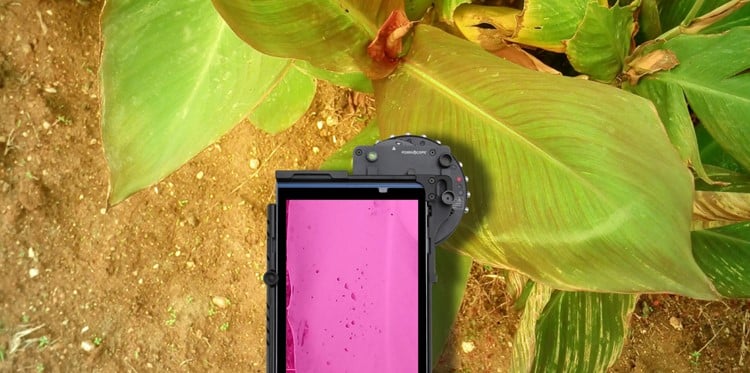
The bloodstains formed at the crime scene can be invisible to the naked eye (latent bloodstains). At this point, a practical and easy-to-use multispectral device is tremendously helpful. In addition to multispectral devices, certain chemicals can be used to reveal bloodstains at a crime scene. Luminol is a chemical mostly used to reveal latent bloodstains as a bright blue luminescent glow by reacting with the iron in the blood. However, it can be damaging to valuable surrounding evidence, such as proteins, enzymes, and genetic markers that could be used in the investigation.