
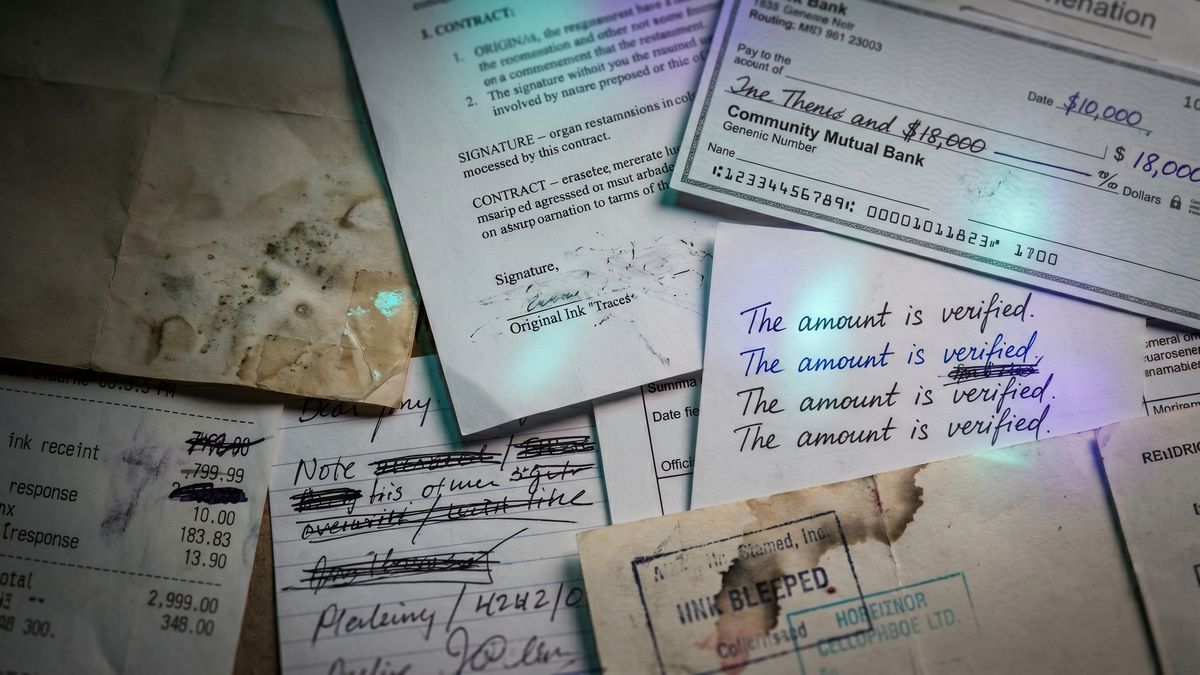
Handwriting and document analysis, a practice dating back to the 16th century, has diversified into many subspecialties and fields of study. Examining a document to determine if it is the work of a specific individual is among the most common procedures. Modern forensic document examination relies on advanced equipment. These methods streamline the work of forensic experts, allowing them to detect even the smallest alterations on a document easily. Document analysis methods vary depending on the document and the specific requirements of the examination. Generally, they fall into two categories: destructive and nondestructive testing methods.
Forensic document experts may use multiple methods simultaneously during an examination. Nondestructive analysis is the preferred approach. Experts can also combine destructive and nondestructive techniques; for example, documents treated with chemical methods can then be examined using light sources of different wavelengths.
Scientists use a variety of alternative light sources in forensic evidence review. Technological advancements continually encourage the emergence of new methods. Ink analysis, signature verification, and the examination of printed text remain primary focuses in forensic document examination.
Multispectral Imaging Methods record the spectral reflection properties of a document across the visible, ultraviolet, and infrared ranges. Lights of different wavelengths are the primary tools in nondestructive inspection. Examiners have various options, ranging from ultraviolet to infrared light.
VIS (Visible) Imaging Method
Visible light has wavelengths between 400 nm and 700 nm. Utilizing high resolution, experts use VIS light to observe alterations on a document by taking macro and micro photographs of the sample.
UV (Ultraviolet) Imaging Method
UV light has wavelengths between 100 nm and 400 nm. Ultraviolet radiation allows experts to view and analyze documents without any physical intervention.
IR (Infrared) Imaging Method
IR light has wavelengths between 750 nm and 1000 nm. Infrared examination reveals content that is otherwise invisible to the human eye. With proper lighting and camera settings, hidden text or later additions to a document become clearly visible.
During ink inspection, IR light helps differentiate types of ink. Under specific IR wavelengths, one ink may be more reflective than another. Because of this property, the expert will observe one ink appearing darker while the other appears lighter.
Ink and writing can be erased in various ways. By adjusting the wavelengths of IR radiation, experts can easily make the erased material visible and readable.
When writing is erased mechanically, small particles of ink or graphite often remain. IR imaging can make these remnants clear. Examining charred documents is sometimes only possible through infrared photography, though success depends on the type of ink and the extent of the charring.
An ideal document examination involves selecting or combining the 8 different filters and 10 narrowband lights of the ForenScope Mobile Multispectral Forensic Tablet. For more detailed reviews, the ForenScope DocEx Tablet provides 10 filters, 33 light options, and various light bands. Adjusting filter and light selections takes only seconds, allowing for quick and efficient analysis.
The ForenScope Mobile Multispectral Forensic Tablet facilitates the review of threatening letters, ink variations, scribbled texts, official paperwork, and credentials. Additionally, the ForenScope Darkroom accessory blocks external light to improve focus. With this accessory, experts obtain high quality images clearly and accurately.