
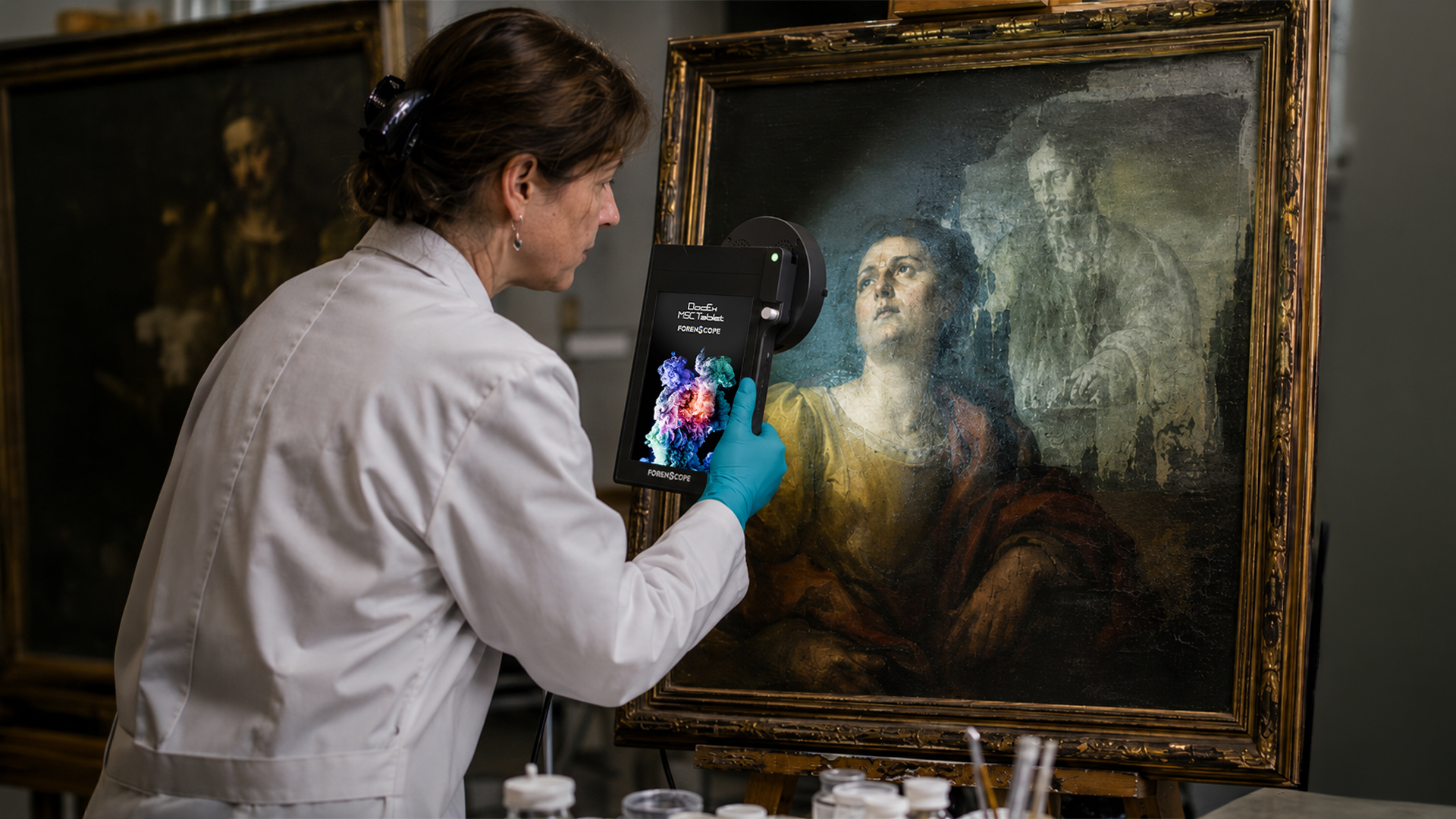
MultiSpectral imaging technology, while foundational to forensic science, plays an equally critical role in the authentication and analysis of artworks and historical artifacts. The initial phase of any art examination always involves visual analysis beginning with naked eye or magnified observation under visible light, followed by multi wavelength photography. Because different light wavelengths reveal distinct surface and subsurface anomalies, devices such as the ForenScope MultiSpectral Forensic Tablets provide conservators with a practical, compact solution for visualizing materials across a broad spectrum, including Infrared (IR), Ultraviolet (UV), and Visible (VIS) light, utilizing specialized filters.
The Principles of Ultraviolet (UV) Analysis
Museums, auction houses, and galleries frequently rely on UV photography as a primary diagnostic tool because it offers a rapid, non-destructive, and cost-effective method for artifact analysis.
When UV light interacts with an artifact, it induces visible surface fluorescence. The exact nature of this fluorescence depends on several variables: the specific wavelength of the transmitted light, the chemical composition of the materials (pigments, dyes, binders, and varnishes), and the natural aging process of these compounds.
Generally, an absence of fluorescence on a traditional painting indicates recent retouching or freshly applied paint. Conversely, modern synthetic varnishes typically emit a light blue glow under UV exposure, while aged natural resins fluoresce with an intense green hue. These distinct optical signatures allow conservators to accurately map the dimensions of prior restorations and gather qualitative data on pigment composition (though definitive pigment identification ultimately requires supplementary analytical methods).
Material Applications and Anomaly Detection
UV imaging is highly versatile and applicable across a wide range of organic and inorganic materials, including paintings, murals, manuscripts, textiles, ceramics, glass, paper, leather, ivory, and gemstones. By analyzing the differential radiation and reflection of historical versus modern materials, experts can readily detect subsequent additions, overpainting, and forgeries.
Specific material reactions under UV light include:
Paintings and Retouching: Restorations performed within the last century often manifest as black smears or purple blotches. Furthermore, applying a modern varnish over an antiquated painting yields a distinct, unusually bright optical signature.
Marble and Ivory: Antiquated, naturally aged marble or carved ivory emits a dull white fluorescence. In contrast, freshly cut or newly processed materials produce a stark, bright purple fluorescence, clearly distinguishing modern counterfeits from historical originals.
Paper and Photographs: UV analysis easily differentiates original collectible prints and postcards from modern reproductions. It is also highly effective at visualizing “foxing” (brown, mold-induced biological degradation on paper) and identifying “silvering” (surface contamination and chemical degradation in antique photographs).
Stratigraphic Analysis: Under magnification, UV light assists in distinguishing individual layers within microscopic paint cross-sections, isolating pigments on unvarnished surfaces.
Case Application: Mobile Multispectral Analysis
To demonstrate the efficacy of this technology, two 21st century paintings one oil and one watercolor were examined using the ForenScope Forensic Tablets, utilizing the UV1 light setting paired with a UV/VIS filter.
During the examination of the oil landscape, the primary oil pigments did not exhibit distinctive fluorescence. However, isolated areas of high-intensity fluorescence were detected. By cross referencing these UV images with standard white-light photography and magnifying the anomalous areas, analysts determined that the fluorescent signatures were not the result of deliberate brushstrokes. Instead, the multispectral comparison revealed underlying structural damage to the canvas and the presence of a foreign liquid spill.
This level of non-invasive detection provides forensic experts and art authenticators with critical baseline data regarding the physical integrity, preservation history, and authenticity of the artifact.