
Wound morphology provides critical clues regarding both the class characteristics of the bladed weapon used and the dynamics of the attack. For instance, a slashing motion typically produces incised wounds that are longer than they are deep, whereas a stabbing motion with a pointed weapon results in deep puncture wounds. By examining the wound pathways, margins, and the sequence of injuries, forensic pathologists can effectively reconstruct the event and determine the fatal blow.
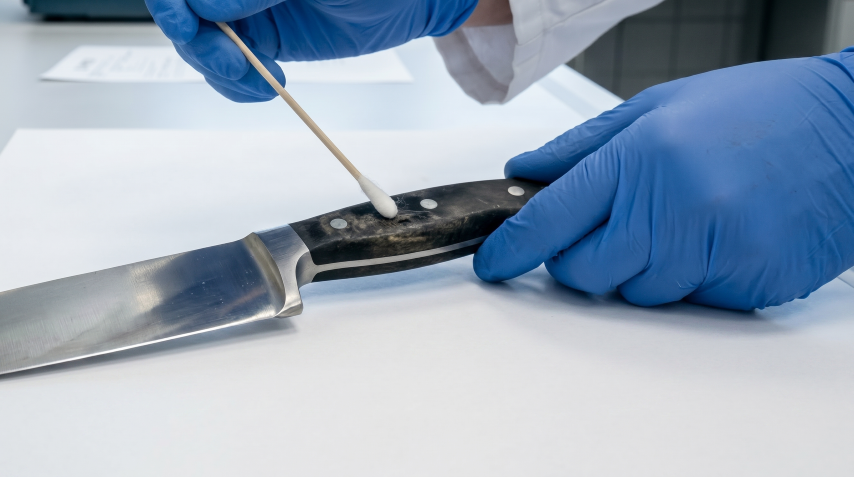
When biological material such as the blood of the victim or the perpetrator—is left on a weapon, it transforms into a pivotal piece of forensic evidence. Analyzing a knife recovered from a crime scene can yield blood typing, latent fingerprints, and DNA profiles extracted from blood or shed epithelial cells.
The ability to generate DNA profiles from epithelial cells left behind by simple contact—commonly known as “Touch DNA” or trace DNA emerged over two decades ago. Since then, extraction methodologies have advanced significantly, requiring progressively less biological material to develop a viable genetic profile. Touch DNA relies on the transfer of nucleated and keratinized epithelial cells shed from the epidermis during physical contact. Because the quantity of deposited genetic material is typically minute, the term “low-template DNA” or “trace DNA” is frequently used in forensic biology.
The likelihood of recovering a full DNA profile depends heavily on the “shedder status” of the individual, their activities prior to contact, and the substrate of the object touched. Recovery rates vary significantly across different surfaces; studies indicate a success rate of approximately 9% for glass, 23% for fabrics, and 36% for rougher, porous surfaces like wood.
Identification via trace DNA has become a standard tool in modern casework worldwide. One of the most high-profile cases illustrating the complexities and potential pitfalls of Touch DNA is the 2007 murder of British student Meredith Kercher in Perugia, Italy, which led to the wrongful conviction and eventual acquittal of American student Amanda Knox and her then-boyfriend, Raffaele Sollecito.
While a third suspect, Rudy Guede, was definitively linked to the crime scene and the victim through multiple matching DNA profiles (and subsequently convicted of the murder), the case against Knox and Sollecito relied heavily on controversial, low-level trace DNA evidence. Since no murder weapon was found at the immediate scene, investigators focused on a large kitchen knife recovered from a cutlery drawer in Sollecito’s apartment.
Forensic analysis of this knife yielded a Low Copy Number (LCN) DNA profile matching Knox on the handle and a highly disputed trace profile attributed to Kercher on the blade. Another critical piece of evidence was a trace DNA profile matching Sollecito found on Kercher’s severed bra clasp, which was collected from the crime scene days after the initial processing.
The defense heavily scrutinized this trace evidence, arguing that the DNA quantities were too low for reliable profiling and highlighting severe breaches in crime scene management and chain of custody that likely led to cross-contamination. Following an extraordinary series of appeals, retrials, and shifting verdicts over eight years, the Supreme Court of Italy ultimately acquitted Knox and Sollecito in March 2015. The case remains a landmark study in the forensic community, emphasizing the critical importance of rigorous evidence collection protocols and the inherent risks of relying solely on low-template Touch DNA without corroborating contextual evidence.